

By FIFAfrica |
The Forum on Internet Freedom in Africa (FIFAfrica) has evolved in tandem with the prevailing concerns related to the internet in Africa. At its inception in 2014, discourse centred around who is connected and how to access information. While this remains pertinent today, Africa’s digital ecosystem has become far more complex.
This year, the Forum is hosted by the Collaboration on International ICT Policy in East and Southern Africa (CIPESA) in partnership with Mauritius-based Halley Movement Coalition. The keynote speech will be delivered by the Minister of Information Technology, Communication and Innovation, of Mauritius.
FIFAfrica has become one of the continent’s most important convening spaces for shaping debate on digital rights, internet governance, and civic freedoms. Its continued relevance lies in its ability to remain closely attuned to the changing realities of Africa’s digital landscape, since its inception in 2014.
Within Africa’s digital rights ecosystem, the Forum serves the strategic function of connecting research, advocacy, policymaking, movement building, and public interest engagement in one forum. FIFAfrica is particularly significant because it places African digital rights interests within wider global conversations on technology governance, including for the Internet Government Forum (IGF), the World Summit on the Information Society (WSIS), and numerous others. At a time when decisions on Artificial Intelligence (AI), digital public infrastructure, content moderation, cross-border data governance, and online freedoms are increasingly shaped through international processes, FIFAfrica positions African stakeholders to contribute evidence and shape narratives in ways that are rooted in the continent’s own political, economic, and social contexts.
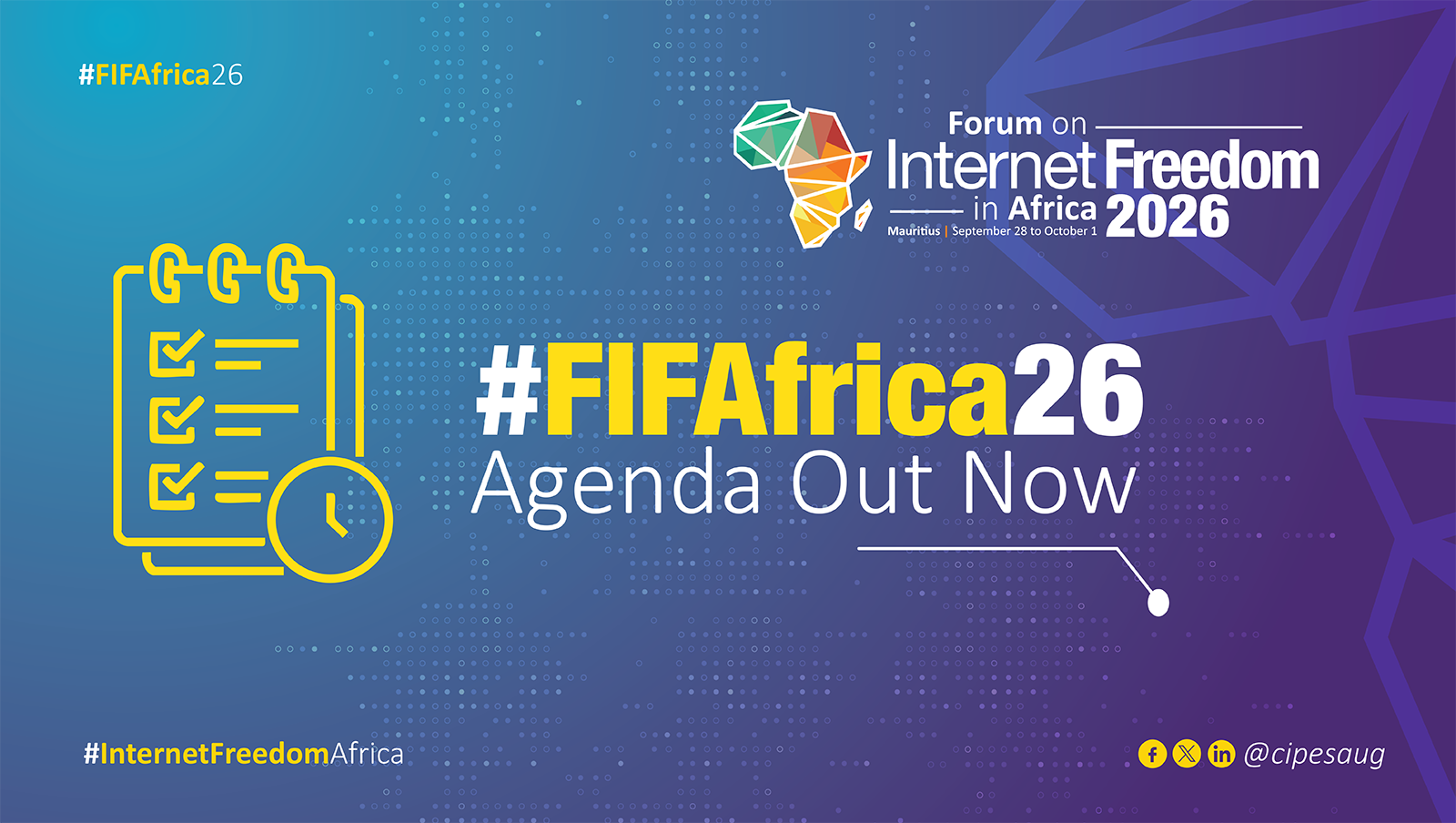
The four-day Forum kicks off with two days of 18 pre-events, followed by two days of the main programme which features 41 stand-out sessions, with participants from across Africa and beyond. The Forum has eight thematic areas covering digital democracy and civic participation, data governance and sovereignty, AI and emerging technologies, platform accountability, digital inclusion, digital economy and trade, movement building, and digital security and safety.
The agenda is built out of a selection of submissions received from more than 450 proposals received via a public call for sessions and travel support. The diversity of sessions submitted and selected is a reflection of the multiplicity of issues that the African tech ecosystem needs to address, many of which cannot be addressed in isolation. Questions about human rights and democracy increasingly intersect with technology and information. Meanwhile, data governance is tied to economic interests, while AI raises questions about exploitation, information integrity, access to information, and discrimination.
There will be strategic engagement between regulators, parliamentarians and the judiciary from across Africa on the Malabo Convention in a session hosted by Mzalendo Trust in partnership with CIPESA and the African Parliamentary Network on Internet Governance (APNIG). Further sessions engaging National Human Rights Institutions (NHRIs) on human rights and technology will be hosted by the Danish Human Rights Institute in partnership with CIPESA and the International Commission of Jurists (ICJ). The Forum will also serve as the host of the pre-launch of the Copenhagen Principles for the Protection of Human Rights in the Digital Age.
Meanwhile, AI remains a focus area of discussion due to its intersection with data protection, worker rights, access to information, information integrity, and democracy. Entities including Digital Action, the Global Center on AI Governance, the Electronic Frontier Foundation (EFF), the African Internet Rights Alliance (AIRA), the Digital Rights Alliance of Africa (DRAA), BBC Media Action, UNESCO, Article 19, Lighthouse Reports, Africa Uncensored, the Office of the United Nations High Commissioner for Refugees, and the Oversight Board will explore these concerns, including through the lens of child online safety, migration, media regulation, digital markets, and digital democracy.
Further sessions entail discussions on the state of data governance, civic space, strategic litigation, technology and human rights, digital identity, DPI, gender and civic participation as part of broader debates on data, power and emerging technologies. Speakers will be drawn from entities such as Oxfam, Pan African Lawyers Union (PALU), and the Digital Impact Alliance (DIAL).
Platform accountability is also a key area of interest, including how it can be humanised, while sessions on corporate power and the push-back against internet shutdowns will involve speakers from Nguvu Collective, Lumate, and the Oversight Lab. Long-term FIFAfrica partner, Access Now, will host a session marking a decade of the #KeepItOn campaign. Internet shutdowns remain key violations of freedom of expression and access to information on the continent and also have significant economic and infrastructural consequences.
For years, platform regulation has often been framed around content moderation and how platforms should respond to harmful content. However, various FIFAfrica26 sessions are extending the debate into how platforms collect and use data, how they design recommendation and advertising systems, how they assess risk, how they respond to government demands, how they conduct due diligence, and what remedies they provide to people harmed by their systems. This is particularly important in Africa, where the global scale of technology companies is vastly greater than the capacity of national regulators and courts to scrutinise them. Entities such as CIPESA, GIZ, the Oversight Board, and EFF will host sessions challenging these narratives.
Sessions at the Forum will also reflect on shrinking civic space online and offline across the continent, including learnings from the cancellation of Rightscon and the rise in authoritarian practices across the continent. These will be candidly addressed by Access Now, RightsCon, and Amnesty International.
Practical sessions also form part of the agenda, with Masakhane, International Research & Exchanges Board (IREX) and the Human Rights Foundation (HRF) each hosting skills workshops on Safety By Design for African tech ecosystems, AI and languages, as well as Bitcoin as a tool for human rights activism and civil society respectively.
FIFAfrica26 continues in its path of inclusion and will entail language interpretation and adherence to a code of conduct that encourages active participation and contribution online and offline.