

By Sheena G. Magenya |
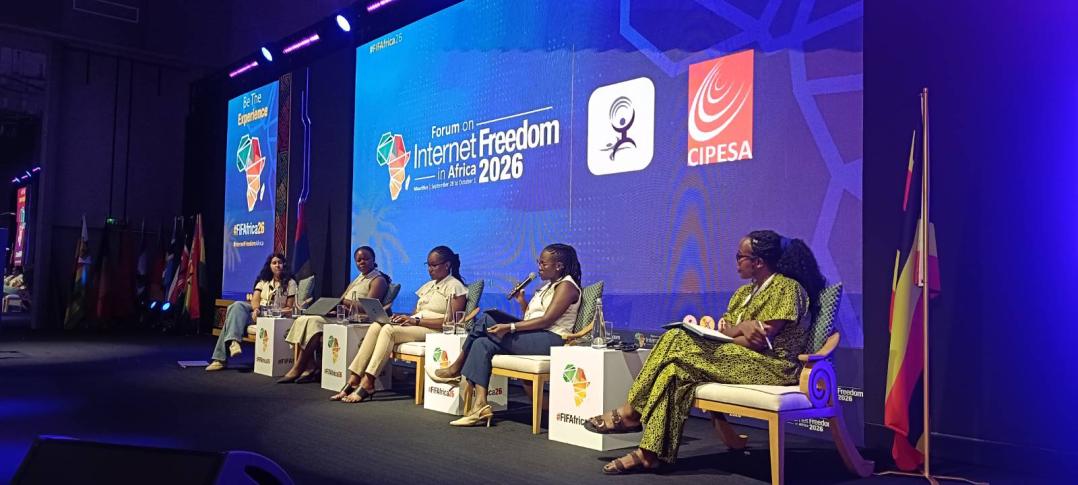
The Collaboration on International ICT Policy for East and Southern Africa (CIPESA), APC’s longstanding member in Uganda, hosted the 13th edition of the Forum on Internet Freedom in Africa (FIFAfrica26) in Balaclava, Mauritius, between 28 September and 1 October 2026. Around 500 multistakeholder participants – including policy makers, technology practitioners, researchers, journalists, civil society organisations, private sector actors and digital rights advocates working on digital rights, inclusion and governance in Africa – shaped this year’s agenda, which was dominated by conversations around data governance and sovereignty, artificial intelligence (AI) and emerging technologies, platform accountability, digital inclusion, the digital economy and trade, digital democracy and civic participation, and digital security and safety.
Taking forward our initiative to engage with the APC community in the region at FIFAfrica, we invited members, partners and staff attending this year’s edition to share some insights, prompting reflections on local agency, infrastructure sovereignty, technology-facilitated gender-based violence (TFGBV), AI and more.
A call for sovereignty in digital rights and governance in Africa
For many APC members and partners attending this year’s FIFAfrica26, the forum comes at an important time on the continent, when various emerging technologies and platforms, including AI and digital public infrastructure (DPI), are dominating governance, inclusion and infrastructure discourses and advocacy efforts. Africa-based APC members attending FIFAfrica26 noted that the involvement of civil society organisations in decision-making spaces and the introduction of instruments aimed at ensuring the safe deployment of DPI is essential. Esther Nyapendi (Uganda) with the Women of Uganda Network (WOUGNET) highlighted the importance of ensuring the protection of citizens’ data by states and the meaningful inclusion of women and girls in these processes.
“In Uganda there are quite a few platforms that the government has established, which creates considerable concern when it comes to data protection and privacy of its citizens, and specifically for the communities that we work with who are women and girls,” Nyapendi reflected. “When we look at a lot of the systems and digital platforms that the government uses, there is interest in wanting to audit these systems: looking at how they work, how they are built, what data is being collected from different groups of people, in particular minority groups, as well as to monitor if these systems will evolve to ensure that decision making for women and girls is included,” she added.
In the many panels, conversations and lightning talks that took place at FIFAfrica26, the word “sovereignty” came up time and again. The desire for Africa and Africans to design, develop and promote home-grown technologies and innovations is present. While speaking to emerging technology like AI, panellists and several sessions highlighted the importance for Africa and Africans to invest in the development of AI models that respond to the needs of Africans.
In 2026, Africa is past being invited to spaces that limit state and civil society input to internet governance and digital rights of platforms that Africans do not own or did not develop. APC associate Koliwe Majama (Zimbabwe) from the Masakhane Project reflected on the question of the sovereignty of African states and digital infrastructure. Majama proposed that we complicate the sovereignty debate by not limiting our demands to governance, but extending the conversation to also reflect on inclusion and infrastructural sovereignty.
Majama stated, “There’s governance sovereignty, but there’s also inclusion sovereignty and infrastructural sovereignty, right? We need to decide which one of these is a priority for us in Africa. When you look at Africa, the digital rights context is very linked to the economic status of a region or a country specifically. This makes it important for us to come up with models that go beyond building a consortium, writing a proposal, getting grants or coming up with alternative funding models.”
“At present we’ve got infrastructure builders building these databases and collecting all this data on the state of Africa’s digital ecosystem,” Majama continued, asking, “Can we sell this to our governments to influence decision making which ensures that the services that we want are available?”
While the desire for sovereignty is also being used by some states to curtail freedoms for their citizens, the demand for more control over the movement of Africa’s data capital, decision making about how digital infrastructure is governed in Africa, and what inclusion can look like is right on time for a continent that holds the most potential both in terms of people and resources. In his opening speech, the executive director of CIPESA, Wairagala Wakabi, pointed out that despite being home to approximately 18% of the world’s population, Africa’s entire computing capacity at present is less than 1% of the world total. Wakabi invited participants to interrogate our digital rights and governance work beyond regulation and invest in conversations and initiatives that also highlight AI governance, justice and capacity development for Africa, by Africans.
He also highlighted the important connection between digital rights work and democratic environments, run by states that are not intimidated by activists and digital rights actors holding them accountable. He noted, “Mauritius is a democracy with respect for rights, and so they were comfortable hosting FIFAfrica26. The countries that would be reluctant to host this event on the African continent are many.”
Bridging the gap between solutions and implementation
APC team’s participation in FIFAfrica26 began with a pre-event on “Technology-Facilitated Gender-Based Violence (TFGBV): Africa-Centred Data and Policy”. This pre-event brought together civil society, researchers, academics and government representatives to engage with findings from the APC initiative the Feminist Internet Research (FIRN). Findings around the experiences of TFGBV from 10 Global South research reports were shared and participants across their varied contexts invited to engage with the findings.
Policy makers and advocates interacted with researchers and activists to explore the potential for this research in influencing cross-ranging responses and initiatives aimed at addressing the far-reaching impact that TFGBV has on majority women, girls, and gender diverse people.
Bringing together various actors to explore the issue of TFGBV was an eye-opening experience for Y. Z Ya’u (Nigeria), executive director of the Centre for Information Technology and Development (CITAD). Y. Z reflected that this pre-event highlighted the missing link between policy development and implementation of interventions addressing TFGBV. He observed that within the Ugandan context, public servants and service providers like the police lack both an understanding of TFGBV experiences and the necessary social support from existing systems; this must be considered when presenting remedies.
Ya’u reflected, “At the APC-hosted pre-event on technology-facilitated gender-based violence, one of the simplest things came to my mind, which I had never considered doing, was the perception of law enforcement agencies when people report technology-related gender-based violence.”
“I heard one of the speakers from Uganda say that when they get a complaint of technology-facilitated violence, the police say oh, go and abuse back. That struck me as important, as perhaps we also need to find out how duty bearers think about and how they enforce such incidents. Duty bearers’ understanding of such issues is something I think that you take for granted, but they have a serious implication for the work we are doing,” he explained.
Presenting holistic solutions to tech-related issues and concerns
APC was also represented on day one of the Forum in the panel conversation, “Beyond One-Off Solutions: Feminist Solutions to Building Women’s Digital Resilience in Africa”. The session was moderated by Natasha Msonza (Zimbabwe), and panellists Bonnita Nyamwire (Uganda), Ndeye Fatou Diouf (Senegal) and Sheena Magenya (Kenya) spoke to provocations around how organisations and initiatives are advancing to address the different kinds of inequalities that women and gender-diverse people are facing in various countries in Africa. Emerging from this conversation was the realisation from all panellists that technology alone cannot solve technology-facilitated violence and inequality. Stronger networks of service providers working within communities are needed to address social justice issues that manifest both online and offline.
TFGBV stood out as an important issue that was being addressed through multiple interventions. Diouf, through her organisation AfricTivistes’ Taxaw Temm campaign on online violence, focuses on ensuring that resources to identify and tackle TFGBV are made available to women and girls in hard-to-reach parts of Senegal, while mobilising decision makers to acknowledge and publicly support the call to end TFGBV. Nyamwire, who is the research director at Pollicy, shared findings from the multi-year Centre for International Governance Innovation (CIGI) research on Supporting Safer Digital Spaces, which samples over 18,000 respondents across 18 countries and explores the prevalence and impact of TFGBV. Nyamwire shared that one of the most surprising findings from the study was that an overwhelming amount of research subjects did not report any TFGVB via formal and established channels such as the police. Instead of formal channels, most survivors of TFGBV prefer to seek support and guidance from immediate family members, friends and other people in their close circle of support. Nyamwire highlighted that this research, and over time the FIFAfrica space, has evolved to become a space for first, the acknowledgement of TFGBV, and more recently, multistakeholder investment in addressing this key digital rights issue.
The findings from this research magnified the purpose of this panel, to highlight the need for multiple levels of support, within both online and offline spaces, beyond one-time interventions that leave survivors of TFGBV vulnerable to unclear reporting systems or further abuse at the hands of law enforcement. Highlighting APC’s Full Picture Campaign, Magenya spoke about the importance of an agency-based approach to addressing TFGBV enabled by digital and gendered misinformation and disinformation spread through platforms and recently created by generative AI. By advocating for stronger community-based and offline information verification practices, and taking control of the creation of information online, we can contribute to the dissemination of verifiable and factual information and reduce information pollution on digital platforms that movements and communities depend on for raising awareness and sharing information.
APC’s Africa regional strategy lead, Peace Amuge, participated in a panel on “Engaging with International Frameworks and Mechanisms to Advocate for Women’s Digital Rights”. The panel highlighted the need for policy interventions to keep up with the rapidly shifting digital technology development pace in Africa. The panel spoke to how African and Global Majority voices remain underrepresented in international digital governance and human rights processes, despite global frameworks and policy decisions having direct consequences for communities across the continent. The panel presented and spoke to the Alliance for Universal Digital Rights (AUDRi) framework and toolkit that aim to support feminist and intersectional digital rights advocacy and strengthen engagement with international human rights and digital governance mechanisms such as the Universal Periodic Review process.
In closing, Mrinalini Dayal from Equality Now stated, “Meaningful engagement with advocacy around digital rights needs us to look at all the stakeholders and really bridging the entire cycle with them. This means maybe doing events, panels and continuing that relationship with governments and with specific ministries. It might also mean mapping which countries or embassies or ambassadors have spoken on different issues and are interested in taking the work beyond the report.”
This article was first published by the Association for Progressive Communication on October 15, 2026.